

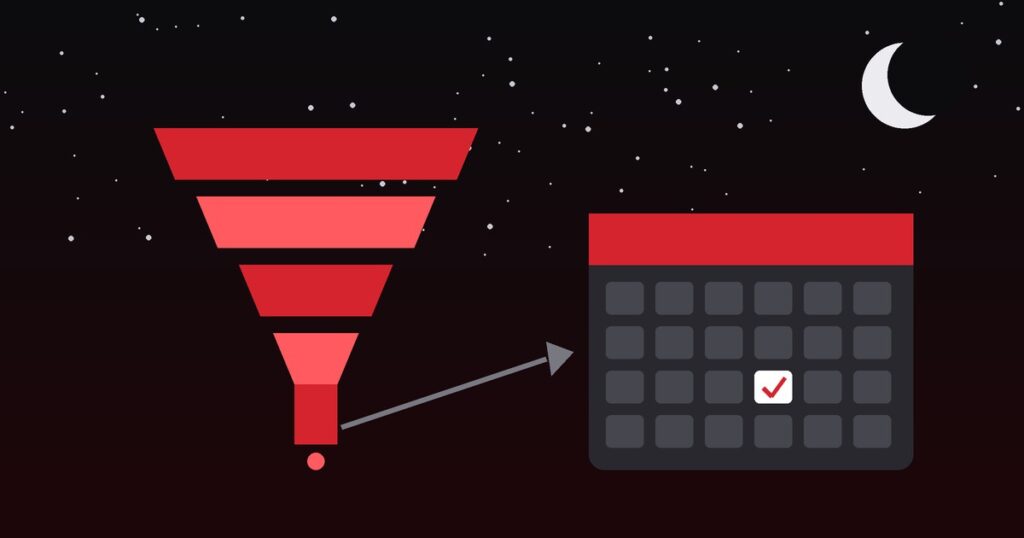
Most businesses don’t have a lead problem. They have a follow-up problem. Someone fills out a form at 9:40 p.m., and the business calls back the next afternoon, if at all. By then the customer has already booked with someone else.
A well-built lead funnel fixes that. And with AI handling the first response, it can keep working after you’ve gone home. Here’s how the pieces fit together.
What Is a Lead Funnel?
A lead funnel is the path a stranger takes to become a booked customer. Each stage has one job: move the person to the next step. When one stage is weak, everything after it suffers. Great ads can’t save a slow landing page, and a great landing page can’t save a lead nobody calls.
The Stages of a Modern Lead Funnel
1. Ad or search
It starts where your customer is looking: a Google search, a Maps listing, a social ad, or a local service ad. The goal is relevance. Someone searching “emergency AC repair” should see an ad and a page about emergency AC repair, not your homepage.
2. Landing page
The landing page has one purpose: get the visitor to take action. Strong landing pages share a few traits:
- A headline that matches what the person searched for
- A clear offer, like a free estimate or inspection
- Trust signals: reviews, licensing, guarantees, photos of real work
- Fast loading on a phone
- One obvious call to action, with tap-to-call and a short form
3. Capture
The form or call is the moment a visitor becomes a lead. Keep forms short. Name, phone, email, and one or two qualifying questions are usually enough. Every extra field costs you leads.
4. Instant AI follow-up by text and call
This is where most funnels break, and where AI changes the game. The moment a lead comes in, an AI sales assistant can:
- Text the lead within seconds to confirm and start a conversation
- Call the lead to qualify the job and answer questions
- Ask the same qualifying questions your best salesperson would
- Respond at 2 a.m. the same way it does at 2 p.m.
5. Booking
Instead of “we’ll get back to you,” the AI offers available times and books the appointment straight onto your calendar.
6. Reminders
No-shows are expensive. Automated reminders by text and email, with an easy way to confirm or reschedule, help protect your calendar.
7. Review request
After the job, the funnel asks happy customers for a review. Those reviews feed back into the top of the funnel by building trust with the next searcher, which closes the loop.
Why Speed to Lead Matters So Much
Leads go cold fast. Research published in Harvard Business Review found that firms that tried to contact online leads within an hour were nearly seven times as likely to qualify the lead as those that waited even an hour longer, and far more likely than firms that waited a day or more. The same research found many companies took far longer than that to respond, or never responded at all.
The study is from 2011, but the lesson has only grown stronger as customers have gotten used to instant everything. If you’re not first, you’re often not considered.
The problem for most small businesses isn’t that they don’t care about speed. It’s that nobody is free to respond in the moment. The owner is on a job, the office is on another call, or it’s after hours. That’s exactly the gap AI follow-up fills.
Nurturing: The Leads That Aren’t Ready Yet
Not every lead is ready to book today. Some are getting quotes. Some are planning for next season. Without nurturing, those leads disappear.
A good nurture sequence:
- Stays helpful, not pushy. Share tips, answer common questions, and remind them what you offer.
- Uses more than one channel. A mix of text and email reaches more people.
- Has a clear next step in every message. Book, reply, or call.
- Knows when to stop. Respect opt-outs and don’t over-message.
- Hands off hot leads fast. When a lead re-engages, the AI or your team responds immediately.
A note on consent
Automated texting and calling come with rules. The FCC has confirmed that AI-generated voices are treated as artificial voices under the Telephone Consumer Protection Act, which generally means you need the person’s prior consent for those calls. Build consent language into your forms, honor opt-outs right away, and work with a provider who takes compliance seriously.
Practical Takeaways
- Map your funnel stage by stage and find the weakest link. It’s often follow-up.
- Match ads to landing pages. Relevance beats cleverness.
- Keep forms short and make calling easy on mobile.
- Respond to new leads in minutes, not hours. AI makes that possible 24/7.
- Book on the first contact when you can, and send reminders to cut no-shows.
- Nurture leads that aren’t ready, and ask every happy customer for a review.
- Get consent for automated texts and calls, and honor opt-outs.
TargetWize.ai AI-Driven Funnels and the AI Sales Assistant
TargetWize.ai, the AI services sister brand of Lead Wize Solutions, builds AI-driven funnels for local and service businesses. We connect the whole path: targeted ads or search visibility, fast landing pages, lead capture, and the TargetWize.ai AI sales assistant, which follows up instantly by text and call, qualifies leads, books appointments on your calendar, sends reminders, and asks for reviews after the job.
It pairs with the Lead Wize sales funnel marketing team, so strategy, ads, and AI follow-up work together instead of in separate silos. Learn more on the TargetWize.ai page.
Let Your Funnel Work the Night Shift
Book a free discovery call and we’ll walk through your current funnel and show you where AI follow-up would make the biggest difference. Or start with a free digital footprint analysis. Prefer to talk now? Call 844-925-WIZE (9493).